Project
Becomings
engage · learn · reimagine · grow
Reimagining recovery narratives following adversity
Collaborative Knowledge-Making
Understanding how knowledge developed through participation, dialogue and encounters between different forms of expertise.
Knowledge Was Made Together
Project Becomings began from the position that people with lived experience of trauma and recovery hold forms of knowledge that cannot simply be replaced by professional, clinical or academic expertise.
Co-researchers therefore participated not only by providing experiences for the researcher to analyse, but through questioning, discussing, responding to and developing ideas throughout the research.
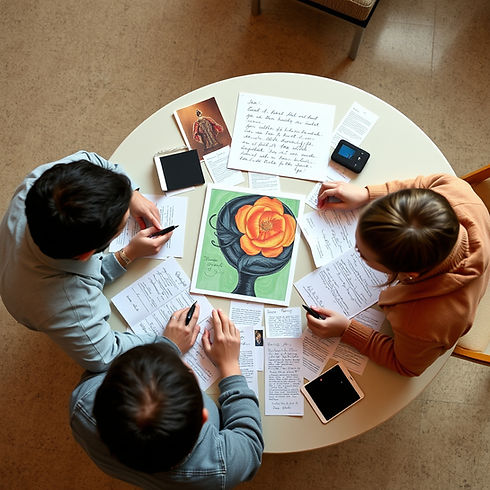
Knowledge emerged through conversations between co-researchers, encounters with creative practices and materials, reflections between sessions and the revisiting of ideas as the project developed. Different perspectives could reinforce one another, but they could also challenge, complicate or disrupt what appeared to be becoming known.
This mattered because collaborative knowledge-making was not about reaching agreement on a single definition of recovery. Difference itself could be analytically important. One person's experience could sit alongside another's without either needing to become representative of everyone.
The researcher's knowledge also remained part of this process. Academic theory, methodological knowledge, lived experience, researcher reflexivity and the experiential knowledge of co-researchers came into relation rather than one form of knowledge automatically being positioned as the authority over the others.
Collaborative knowledge-making therefore involved creating opportunities for understandings of recovery to be developed, questioned and changed through participation, rather than treating survivor knowledge as something collected and interpreted only after it had been handed to the researcher.
Agreement Wasn’t The Goal
Bringing different experiences together did not mean trying to produce one shared account of what trauma recovery was.
Co-researchers sometimes recognised aspects of their own experiences in what others shared. At other times, their perspectives differed, contradicted one another or held tension being brought together into a single explanation.
Rather than treating these differences as something that needed to be resolved, Project Becomings allowed multiple forms of knowledge to remain alongside one another. What enabled recovery for one person might constrain another. Something experienced as supportive in one context might feel very different in another.
These differences were important because they challenged the idea that there could be one universal pathway, experience or definition of recovery. They also prevented the knowledge produced through the research from becoming a new set of rules about what recovery should look like.
Moments of uncertainty were important too. Co-researchers did not always have an immediate explanation for an experience, and the research did not require every question to reach a clear answer. Not knowing could create space for something previously taken for granted to be questioned or encountered differently.
Collaborative knowledge-making therefore involved learning from agreement, difference, contradiction and uncertainty. The aim was not to make diverse experiences fit together neatly, but to remain attentive to what became possible when they were brought into relation.


Revisiting And Reworking Knowledge
What someone thought, felt or understood about recovery at one moment in Project Becomings did not have to remain the same.
Ideas could travel across the research. Something discussed during a workshop might be encountered again through a creative practice, reflected upon later through Indeemo, or return within another conversation. Each encounter created the possibility of seeing, feeling or understanding something differently.
This meant that earlier contributions were not necessarily treated as final accounts of what somebody believed or experienced. Co-researchers could reconsider ideas, make new connections, question previous assumptions or find that something which had once seemed important became less significant over time.
Creative practices were particularly valuable within this process because revisiting an idea did not always mean simply talking about it again. Working with an image, material, body map or other form could bring different aspects of an experience into view and enable knowledge to develop in ways that conversation alone might not.
Knowledge-making therefore became a process of returning and reworking, rather than progressively moving towards one increasingly certain answer.
This also meant that change within the research mattered. A contradiction between something expressed earlier and something encountered later did not necessarily mean that one account was incorrect. It could tell us something about how knowledge itself changes through different relations, experiences and moments in time.
Collaborative knowledge-making was therefore not simply about whose voices were included. It was also about creating conditions in which understandings could remain open enough to move.
Different Knowledges, Different Expertise
Project Becomings brought different forms of knowledge into relation. Co-researchers brought lived and experiential knowledge of trauma and recovery. The researcher brought their own lived experience alongside academic, methodological and theoretical knowledge. Creative practices and materials could also enable forms of knowing that did not begin with either academic explanation or spoken accounts.
These different knowledges were not treated as interchangeable. Each could make different things visible, while also carrying its own limitations.
Academic theory, for example, could provide concepts through which an experience might be considered differently, but it was not positioned as the authority that could determine what a co-researcher's experience really meant. Equally, an individual lived experience could offer important knowledge without being expected to represent the experiences of all survivors.
Bringing different forms of expertise together therefore involved dialogue rather than hierarchy. Ideas could encounter one another, create connections, generate tensions or challenge assumptions that had previously seemed settled.
The researcher's role remained significant within this process. Decisions still had to be made about interpretation, theory and what eventually appeared within the thesis. Collaborative knowledge-making did not remove that responsibility or make every decision collectively owned.
Instead, it required greater attention to whose knowledge was shaping an interpretation, what other understandings might be possible and what might be lost when one form of knowledge was privileged over another.
Knowledge about recovery could therefore emerge through relations between different forms of expertise without requiring those differences to disappear.
