Project
Becomings
engage · learn · reimagine · grow
Reimagining recovery narratives following adversity

The Exhibtion Space
Experiencing Project Becomings as a space of movement, sound, materiality and encounter
Project Becomings was designed as more than a space in which research outputs could be displayed. The arrangement of the exhibition, the sounds within it, the positioning of the works and the ways visitors could move between them were all considered as part of the experience.
There was no single route visitors were expected to follow. Different parts of the exhibition created different kinds of encounters — some open and playful, others quieter, more intimate or deliberately uncomfortable. Visitors could move towards what drew their attention, spend time with particular works, participate in creative activities, or step away when they needed to.
This page offers a visual journey through the exhibition as a whole.

A Space To Encounter Recovery Differently
The exhibition brought together clay, thread, drawing, animation, body mapping, sound and written accounts within one shared environment.
Rather than organising these into a single story about trauma or a progression from being “unwell” to “recovered”, different experiences were allowed to exist alongside one another. Visitors could make their own connections between the works as they moved through the space.
Sound formed part of the exhibition environment. A specially curated soundtrack played continuously throughout the space. It was deliberately neither sombre nor overly uplifting. Instead, the music was intended to create a thoughtful atmosphere in which visitors could spend time with the work without being told how they should feel.
The Inner Child - Clay Work
Encountering The Inner Child
Clay works developed through the exploration of the Inner Child occupied the central exhibition space.
The works were displayed openly, allowing visitors to move around and between them and encounter the considerable variety in what co-researchers had created.
Some were playful, some painful, some hopeful, and many held several of these things at once.


Time - Thread Work
Time suspended in the space
The thread and textile works exploring Time were suspended from metal grids within the exhibition.
Hanging rather than being fixed flat against a wall allowed the works to occupy the space differently.
Visitors encountered the threads, knots, stitches, layers and materials while moving through the exhibition — reflecting some of the complexity, entanglement and unevenness through which time had been explored within the research.
Keys — Drawing & Animation
Different ways of opening and closing
Drawings and stop-frame animations developed through Keys were displayed across the exhibition, with animations playing on a continuous loop.
The works explored the many different human and more-than-human influences that could open possibilities for recovery or make them harder to access. Displaying still and moving images together also brought another form of movement into the exhibition space.


The Body Mapping Space
Entering a more intimate space
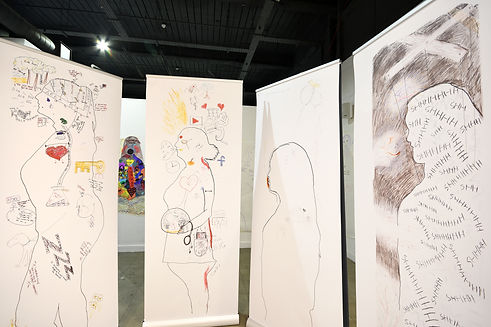
The body maps were displayed within a separate, enclosed area towards the rear of the exhibition. The space was intentionally designed to feel different from the more open exhibition around it.
There was only one way in and out. Inside, the body maps surrounded the visitor, creating a close and intimate environment. The intention was to evoke something womb-like — enclosed, bodily and held apart from the wider exhibition.
Voices in the room
A loop of recorded voices played within the space. The voices repeated kinds of comments survivors had encountered in relation to trauma and recovery, including:
“Why aren't you better yet?”
“It was so long ago.”
“Just leave it in the past.”
Rather than providing an explanation of the body maps, the sound created an atmosphere around them. Familiar assumptions and expectations about trauma recovery repeatedly entered the space.
The intention was not to make the visitor comfortable. The voices introduced something of the discomfort of being questioned, misunderstood or positioned as different — of being made to feel othered — while standing amongst intensely personal representations of embodied experience.

A Place to Step Away
Creating space for choice
Engaging with material about childhood trauma can bring unexpected emotional responses. Alongside the exhibition spaces, we therefore created a separate private area for anyone who wanted time away from the exhibition.
Visitors did not need to explain why they wanted to use it. It offered somewhere to be alone, pause and take some time before deciding whether to return to the exhibition.
This was part of a wider approach to care within Project Becomings: inviting engagement did not mean requiring it. Visitors could choose how closely they engaged, what they spent time with and when they needed to move away.
Creating Alongside
Visitors were invited not only to encounter the work, but to respond and contribute alongside it
The exhibition included spaces where visitors could respond creatively to what they had encountered. People could draw, experiment with stop-frame animation, create body maps, or sit together and make thread work.
The thread-making area offered a place to pause and create alongside others. Visitors could then choose to hang what they had made alongside the existing thread works — gradually adding their own contributions to the exhibition in an expression of solidarity.
Visitors were also invited to create their own body maps. These were displayed on the walls surrounding the co-researchers' body maps, allowing new responses to gather around the original works as the exhibition continued.
In this way, the exhibition was not entirely finished when its doors opened. Visitors could leave something behind, and the physical space changed as people encountered and responded to the work.


Making together
Visitors could sit, make and talk, contributing thread work to hang alongside pieces already within the exhibition.

Responding through the body
Visitor-created body maps accumulated around the co-researchers' works, creating a visible expression of response and solidarity.

Drawing and animation
Drawing and stop-frame animation offered further ways to respond through making rather than words alone.
Moving Through Project Becomings
Visitors moved through Project Becomings in different ways. Some spent considerable time with individual works. Others talked, created, listened, watched or left responses of their own.
The exhibition was therefore not simply a collection of objects produced through the research. The space between those objects mattered too — the sounds, movements, encounters, pauses and choices through which people experienced them.
