Project
Becomings
engage · learn · reimagine · grow
Reimagining recovery narratives following adversity
Researcher Positionality And Reflexivity
Recognising that researchers do not stand outside the research — our experiences, relationships, decisions and actions shape what becomes possible to know.
What Are Researcher Positionality And Reflexivity??
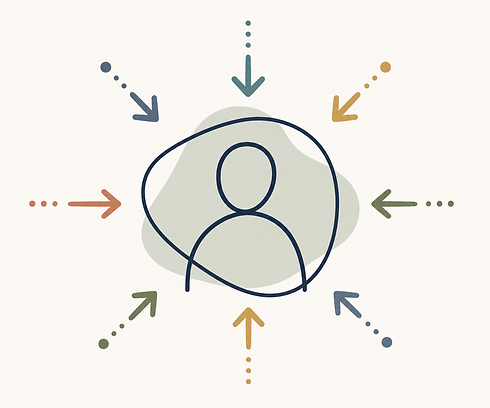
Researchers bring themselves into research, whether they intend to or not. Our experiences, identities, values, assumptions and relationships can influence the questions we ask, what we notice, how people respond to us and ultimately the knowledge that is produced.
Positionality means recognising and making visible where the researcher is positioned within these relationships. This can include our lived experiences and identities, but also our professional roles and the different forms of power we hold. Our position is not necessarily fixed: it can shift across different relationships, spaces and moments within a research project.
Reflexivity is the ongoing practice of paying attention to this. It involves asking questions such as: Why am I interpreting this in this way? How might my experiences be influencing what I notice? How is my presence affecting this encounter? What power do I hold here? What might I not be seeing?
Reflexivity is therefore more than simply reflecting on the research afterwards. It involves continually questioning how we are participating in the research while it is happening — and recognising that the researcher is part of, rather than separate from, the process through which knowledge comes to be produced.

Why Do Positionality And Reflexivity Matter In Recovery Research?
Research about trauma involves experiences that can be deeply personal, vulnerable and shaped by unequal relationships of power. Researchers make decisions about what questions are asked, what is recorded, what becomes ‘data’, how experiences are interpreted and ultimately how other people’s stories are represented.
Being reflexive means recognising the responsibility that comes with this. Even within participatory research, researchers continue to hold particular forms of power. Creating collaborative relationships does not automatically remove differences in roles, experiences or responsibilities.
Positionality also matters because who the researcher is can affect the research encounter. A researcher’s experiences may help them recognise something, create connection or influence what somebody feels able to share. But those same experiences can also shape assumptions about what another person means. Having something in common does not mean having the same experience.
This was particularly important in Project Becomings, where I was researching childhood trauma recovery while also having lived experience of childhood trauma myself. My experiences could not simply be removed from the research, but neither could they be treated as a way of automatically knowing or understanding the experiences of co-researchers.
Reflexivity therefore involved remaining curious about both connection and difference: noticing where my own experiences, emotions and interpretations entered the research, while creating space for co-researchers’ experiences to challenge my assumptions and take the research somewhere I might not have anticipated.
Rather than trying to become a neutral or invisible researcher, the aim was to be accountable for how my presence, position and power participated in what became possible within the research
My Position As A Researcher-Survivor
My position within Project Becomings was shaped by being both a researcher and a survivor of childhood trauma. I did not enter the research as someone standing outside the experiences being explored. My own experiences of trauma and recovery had contributed to the questions I was asking and to my recognition that dominant ways of understanding recovery did not always reflect how recovery was lived.
I use the term researcher-survivor to make this position visible. However, sharing an experience of childhood trauma did not mean that I understood the experiences of co-researchers, or that there was a single ‘survivor perspective’. Each person brought different histories, relationships, bodies, circumstances and understandings of recovery to the research.
My position could therefore create both connections and tensions. At times, lived experience helped create a different kind of relationship between researcher and co-researchers and enabled aspects of my own experience to become part of conversations about recovery. At other times, it required me to question what I thought I recognised: Was I hearing what someone was telling me, or interpreting their experience through my own?
Rather than attempting to remove myself from the research, I worked reflexively with this position. This included paying attention to my emotional and embodied responses, questioning assumptions, and recognising how my experiences, academic role and relationships with co-researchers were participating in what became possible to discuss, make and know.
Being a researcher-survivor was therefore not something I could simply declare and then set aside. It was a position that continually needed to be negotiated throughout the research.


Researcher Self-Disclosure
Being open about my position as a researcher-survivor also raised questions about whether, when and how I should share my own experiences with co-researchers.
Researchers are often encouraged to maintain boundaries between themselves and the people taking part in research. Within trauma research, this can mean participants are invited to share deeply personal experiences while the researcher reveals very little about themselves. I began to question what this unequal exchange might do within research that was intended to be participatory and collaborative.
In Project Becomings, I therefore used researcher self-disclosure: intentionally sharing aspects of my own lived experience when it felt relevant to the research encounter. Disclosure was not about shifting attention towards my story or assuming that my experiences were the same as those of co-researchers. Instead, it could become part of creating a more reciprocal relationship in which vulnerability and personal knowledge did not flow in only one direction.
At times, disclosure helped open conversations, challenge traditional researcher–participant boundaries and create opportunities for deeper discussion. It could communicate that I was not asking co-researchers to enter vulnerable spaces that I was entirely unwilling to enter myself.
But disclosure was not automatically helpful or ethical simply because the research was participatory. What I chose to share, why I was sharing it, how it might affect somebody else and whose needs the disclosure was serving all required consideration. There were also boundaries around what remained private.
Researcher self-disclosure therefore became part of an ongoing reflexive practice: not simply asking “Should researchers disclose?”, but “What is this disclosure doing here, for whom, and what might it make possible?”
Reflexivity In Project Becomings
Reflexivity within Project Becomings was not a single activity completed at one stage of the research. It was an ongoing process of noticing, questioning and responding to what was happening throughout the project.
This meant paying attention not only to what co-researchers said or made, but also to my own responses and actions. I considered how my experiences might influence what I noticed, the questions I asked and the interpretations I made, as well as how relationships between us were developing and changing.
Creative and participatory research also produced situations that could not always be anticipated. A conversation might move in an unexpected direction, a creative work might affect me personally, or something I initially understood in one way could later take on a different significance. Reflexivity meant remaining open to these moments rather than treating my first interpretation as the final one.
Importantly, reflection did not happen only privately. Working with co-researchers created opportunities for interpretations to be questioned, developed and sometimes disrupted. Ideas could be returned to through conversations, creative practices and collective engagement, allowing different perspectives to shape how the research developed.
Reflexivity also meant paying attention to power and responsibility. Although Project Becomings sought to work collaboratively, my role as the researcher carried particular responsibilities and forms of authority. Decisions still had to be made about the research, ethics, representation and what eventually entered academic and public spaces. Calling the research participatory did not make those inequalities disappear.
Reflexivity therefore involved continually asking not only what I was learning, but how that knowledge was being produced, what part I was playing in its production, and whose perspectives might still be missing.


What Did Positionality And Reflexivity Make Possible — and What Tensions Remained?
Making my position visible changed what became possible within Project Becomings, but it also created tensions that could not simply be resolved.
Being open about my lived experience could create possibilities for connection, reciprocity and vulnerability. It challenged the expectation that co-researchers should share deeply personal experiences while the researcher remained distant or unknown, and sometimes enabled different kinds of conversations and relationships to develop.
My position also brought experiential knowledge into the research. I could recognise feelings, tensions or questions through my own embodied and lived experience that might otherwise have remained less visible. But recognition could also become assumption. Something that resonated with my experience did not necessarily mean the same thing for somebody else. Reflexivity required me to remain attentive to that difference.
There were also limits to how far traditional research relationships could be disrupted. I remained responsible for a doctoral project, worked within university systems and ethical requirements, and ultimately held particular responsibilities for how the research was interpreted, written and represented. Participatory intentions did not make these differences disappear.
Rather than seeing these tensions as evidence that the research had somehow failed to be participatory, they became important things to notice, question and remain accountable to. Positionality and reflexivity did not provide a way of becoming a neutral researcher; they helped make visible why neutrality was never really possible in the first place.
What mattered was not removing myself from the production of knowledge, but continually asking how my presence, experiences, relationships and power were participating in what could become known — and what might still remain unseen.
Explore The Research
Project Becomings and its participatory approach are explored in more depth through the doctoral thesis and publications arising from the research.
 |  |  |
|---|