Project
Becomings
engage · learn · reimagine · grow
Reimagining recovery narratives following adversity
Thread Work And Textiles
Exploring time, connection and recovery through material making
In Project Becomings
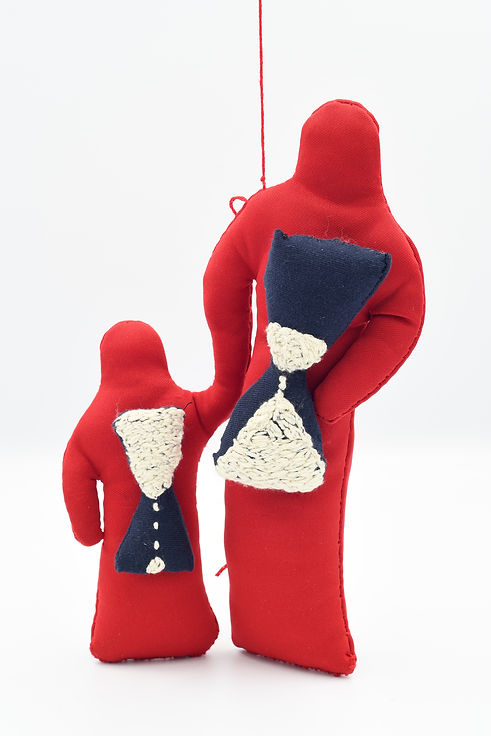
Thread and textile-based making was used within Project Becomings as a tactile and material way of exploring experiences of trauma and recovery. Co-researchers worked with thread and other materials to create pieces through which experiences, relationships and understandings of recovery could take form beyond spoken or written accounts.
Thread became particularly significant in explorations of time. Through processes of connecting, knotting, layering and arranging materials, experiences could be encountered as overlapping and entangled rather than following a simple linear progression from trauma towards recovery.
The resulting pieces became part of the Project Becomings exhibition, where the thread-based work was displayed in ways intended to evoke this sense of temporal fluidity.
About The Method
Thread and textile-based methods use tactile materials such as thread, yarn, fabric and fibres as part of a creative process of exploration and meaning-making. Materials can be knotted, layered, connected, separated, woven or arranged, allowing ideas and experiences to take material form without relying solely on language.
The qualities of the materials themselves can also become part of the process. Threads can stretch, tangle, break, connect and be reworked, creating possibilities for exploring experiences that may feel similarly complex, relational or difficult to represent in a fixed way.
Rather than viewing the finished piece simply as an illustration of an experience, attention can also be paid to what happens through making — including interactions between the person, materials, memories, sensations and ideas that emerge during the process.

Why Use Thread And Textiles In Trauma And Recovery Research?
Experiences of trauma and recovery can be difficult to contain within straightforward narratives. They may involve memories, relationships and emotions that overlap, shift over time or appear contradictory. Working with thread and textiles offers a material way of engaging with this complexity.
The tactile process of handling, connecting, knotting and rearranging materials can create opportunities to explore experiences through doing rather than relying solely on explanation. Materials can be changed, undone and reworked, allowing ideas to remain fluid rather than requiring them to be resolved into a finished or coherent account.
Within Project Becomings, this was particularly relevant to understandings of time. Recovery did not emerge as a linear progression with a clear beginning and end, but as something that could fold across past, present and future. Thread provided a material way of thinking with these connections, interruptions and entanglements.
What Did Thread Work Make Possible?
Thread work created a material way of exploring recovery as something that unfolds across and through time, rather than progressing neatly from a traumatic past towards a recovered future.
Through connecting, knotting, layering and arranging thread, experiences could be held alongside one another without needing to form a single, linear story. Past experiences could remain present, while new connections and possibilities could emerge through the process of making.
For one co-researcher, seeing her artwork later used publicly in the exhibition signage produced an unexpected shift from feeling “invisible” towards a powerful sense of visibility and pride. This illustrates something particularly important within Project Becomings: creative work could continue to act and acquire new meanings through its encounters with different people, places and moments.
Importantly, the materials were not simply used to illustrate ideas that co-researchers already held. Their qualities — their capacity to tangle, stretch, connect, resist and be reworked — became part of how recovery could be thought about and encountered.
This contributed to a wider finding within Project Becomings: matter was not simply a backdrop to recovery or research. Material encounters could actively participate in generating different possibilities for knowing, experiencing and imagining recovery.
